

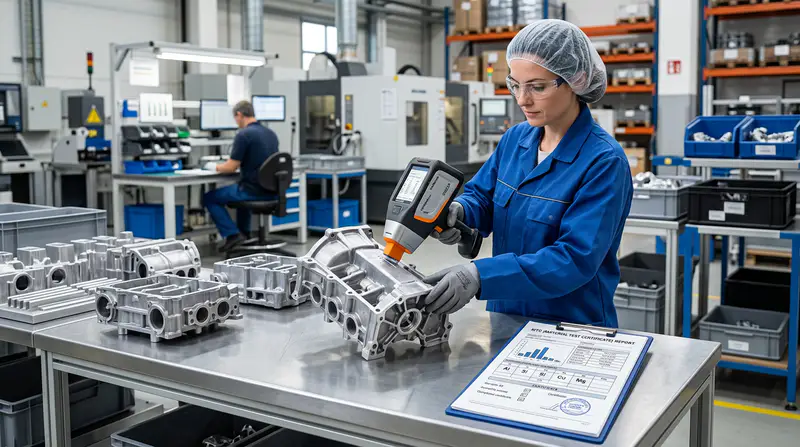
Security screening equipment lives a hard life. Walk-through detectors get bumped by luggage carts around the clock. X-ray units run for years in airport corridors with almost no downtime. Scanner components have to hold tight tolerances while absorbing vibration, heat, and the occasional careless forklift. Behind that reliability sits a supply chain decision that many equipment makers do not spend enough time on: who casts the metal components. Choosing the right partner for aluminum castings for security scanners is not a commodity purchase. It is an engineering decision, and treating it like one is the difference between equipment that holds up in the field and equipment that generates warranty claims.
This article breaks down what security equipment manufacturers should actually evaluate when selecting a casting supplier, beyond the obvious questions about price and lead time.
Why Castings Matter So Much in Security Hardware
Before getting into supplier evaluation, it helps to be clear about why castings carry so much weight in this industry. Security scanners and detection equipment are not simple machines. They combine sensitive electronics, radiation sources in some cases, precision mechanical assemblies, and housings that must protect all of it while surviving public use.
Cast aluminum is a natural fit for this job. It is light, which matters for equipment that gets installed, relocated, and serviced regularly. It conducts heat, which helps passively cool electronics that run continuously. It can be cast into complex shapes that would require multiple welded pieces if fabricated, reducing joints, seams, and failure points. And it can be machined to the tight tolerances that sensor mounts and alignment-critical components demand.
But those advantages only materialize if the castings themselves are good. A casting supplier who delivers inconsistent parts can undo every one of those benefits. That is why the selection process deserves real scrutiny.
Engineering Support, Not Just Production Capacity
The first thing to look for is whether the supplier offers genuine engineering involvement, or whether they simply want your CAD file and a purchase order.
The best casting partners engage before production begins. They review designs for castability, flagging thin walls that will not fill, thick sections that risk shrinkage porosity, and features that will complicate tooling. They help with alloy selection, matching the material to the mechanical requirements, corrosion exposure, and thermal behavior of the end product. And they can run solidification simulations to predict how molten metal will flow and cool inside the mold, catching defect risks on a screen instead of in a batch of rejected parts.
For security equipment specifically, this early engineering work has real consequences. Housings often need to accommodate shielding, cable routing, and mounting for sensitive components all in one shape. A supplier who can help optimize that geometry for casting, while preserving the functional requirements, is worth far more than a low per-part price.
Ask prospective suppliers directly: who reviews our designs, what simulation tools do you use, and what happens when a part will not cast well as drawn? The answers reveal a lot.
Prototyping Capability and Speed to Market
Security technology evolves quickly. New detection methods, updated regulatory requirements, and customer requests for smaller or faster equipment all push manufacturers to develop new products on short timelines. That makes prototyping speed a critical supplier attribute.
Traditional prototyping for castings meant building pattern tooling first, which is expensive and slow when you only need a few parts to validate a design. Suppliers who have adopted additive methods, such as 3D sand printing, can produce molds directly from the digital model and pour prototype castings in a fraction of the time. That lets your engineering team test real cast hardware, verify fit and function, and iterate before committing to production tooling.
When a supplier can move from your design file to a poured prototype quickly, your development cycle shrinks. In a market where being first with a new screening capability matters commercially, that speed is a competitive advantage, not a convenience.
Consistency and Process Control
A single good casting proves nothing. Security equipment manufacturers build products that must perform identically across hundreds or thousands of units, often for customers like airports, courthouses, and government agencies who expect long service life with minimal maintenance.
That level of consistency comes from process control. Ask suppliers how they document their processes: pour temperatures, alloy handling and traceability, mold conditions, timing, and inspection procedures. Ask what happens when something drifts out of spec, and how they catch it before nonconforming parts ship.
Suppliers who treat documentation as an afterthought tend to deliver quality that varies batch to batch. Suppliers who maintain tight process controls can hit the same spec on part number five thousand as reliably as part number five. For equipment that gets installed in high-consequence environments, that reliability is not optional.
Quality Systems and Certifications
Formal quality credentials matter in this sector. Depending on your customer base, you may need suppliers who work within recognized quality management frameworks, maintain material traceability, and can support audits from your own customers. Government and critical infrastructure buyers in particular often flow requirements down their supply chains, and your casting supplier needs to be able to answer those requirements without drama.
Beyond certifications, look at how a supplier approaches inspection. Do they test mechanical properties on the alloys they pour? Do they inspect castings against defined criteria rather than eyeballing them? Can they provide documentation with each shipment? These habits indicate a quality culture rather than a certificate on a wall.
Capacity, Lead Times, and Supply Chain Reliability
Security equipment demand can be lumpy. A large airport order or a government contract can suddenly multiply your component needs. A supplier who is comfortable at your current volume but cannot scale, or who sits at the back of the line when a bigger customer needs capacity, becomes a bottleneck at exactly the wrong moment.
Discuss capacity honestly up front. What volumes can they handle, and how quickly can they flex? Where do their materials come from? A supplier with stable material sourcing and realistic lead times protects your production schedule. One who quotes optimistically and delivers late puts your delivery commitments at risk, and in this industry, missed installations are expensive in ways that go beyond money.
Domestic supply is worth considering too. Shorter shipping routes, easier site visits, shared time zones, and simpler communication all reduce friction, and many public-sector customers now prefer or require domestically sourced components.
Communication and Partnership Behavior
The least quantifiable factor may be the most important. Casting projects involve back-and-forth: design questions, tolerance discussions, schedule changes, occasional problems. How a supplier communicates during the evaluation process predicts how they will communicate during production.
Responsive suppliers who flag issues early, explain trade-offs clearly, and treat your deadlines as their problem are partners. Suppliers who go quiet when a question gets difficult are risks. Pay attention to how they behave before you have sent them any money, because that is the best behavior you are ever likely to see from them.
Making the Decision
No supplier scores perfectly on every dimension. The goal is to find a partner strong on the factors that matter most for your products: engineering depth for complex housings, process control for field reliability, prototyping speed for development cycles, and capacity for growth. Weight those factors against your actual product roadmap rather than defaulting to the lowest quote.
The right casting supplier becomes an extension of your engineering team. The wrong one becomes a recurring line item in your quality reports. For manufacturers whose equipment has to work every single time a traveler walks through it, that choice deserves the same rigor you apply to your own designs.
