

If you work anywhere near manufacturing, machining, or metal fabrication, you’ve probably heard the term thrown around on the shop floor. But if you’re new to the industry, or you’re a buyer trying to understand what your supplier is actually doing to your parts, the phrase can feel a bit opaque. Grinding sounds simple enough until you realize there are several distinct processes hiding behind that one word.
This guide covers the basics of cylindrical grinding, with a focus on its most common form, outside diameter grinding, usually shortened to OD grinding. Whether you’re evaluating cylindrical grinding services for an upcoming project or just want to understand the process better, this should give you a solid foundation.
Grinding in a Nutshell
Before we get specific, it helps to understand where grinding fits in the overall machining picture.
Most metal removal happens through cutting processes like turning, milling, and drilling. These use hardened tools to slice material away in relatively large chips. They’re fast and efficient, but they have limits. A cutting tool can only be sharpened so far, and as it wears, the surface it leaves behind gets rougher and the dimensions drift.
Grinding takes a different approach. Instead of a cutting tool with a handful of edges, a grinding wheel is made of countless abrasive particles bonded together. Each of those tiny particles acts like a miniature cutting edge. Because the material is removed in extremely small amounts by a huge number of tiny edges, grinding can achieve things cutting tools generally can’t: very tight tolerances, very smooth surfaces, and the ability to work with hardened materials that would chew up a normal cutting tool.
In most production workflows, grinding comes near the end. A part might be turned on a lathe, heat treated to harden it, and then ground to bring it to its final dimensions and finish. That finishing role is where cylindrical grinding earns its keep.
So What Exactly Is Cylindrical Grinding?
Cylindrical grinding is the process of finishing the surfaces of a cylindrical workpiece using a rotating grinding wheel. As the name suggests, it’s used on parts that are round: shafts, rods, pins, axles, rollers, spindles, and similar components.
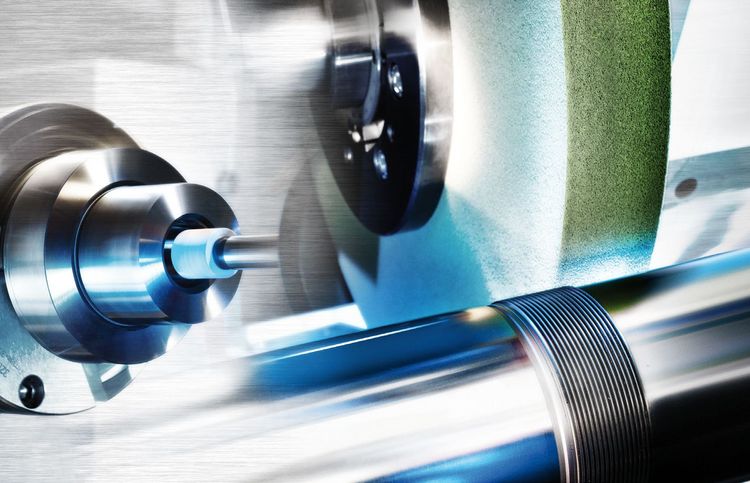
The workpiece is held between centers or in a chuck and rotated while the grinding wheel spins against it. The wheel traverses along the length of the part, removing a thin layer of material with each pass until the part reaches the required diameter, roundness, and surface finish.
There are two main branches of the process:
Outside diameter (OD) grinding finishes the external surface of a cylinder. This is the more common of the two and what most people mean when they talk about cylindrical grinding.
Inside diameter (ID) grinding finishes the internal surface of a bore or hole, such as the inside of a bearing housing or cylinder bore.
Both use the same basic principle, but the tooling and setup differ. This guide focuses mainly on OD grinding since it accounts for the bulk of the work in most shops.
The Four Motions That Make It Work
A cylindrical grinder looks like a complicated machine, but the whole process really comes down to four simultaneous motions:
- The grinding wheel rotates continuously at high speed. This is what actually removes material.
- The workpiece rotates in the opposite direction. The opposing rotation is deliberate. It helps produce a smoother, more consistent cut.
- The wheel feeds toward and away from the workpiece. This controls how much material gets removed on each pass.
- The wheel (or the workpiece, depending on the machine) traverses along the length of the part so the entire surface gets ground evenly.
Because all four motions happen at once, and because the depth of each cut is tiny, the wheel skims the surface rather than gouging it. That’s the secret to the fine finish and accuracy grinding is known for. The wheel never takes a drastic bite out of the metal. It shaves it, pass after pass, until the part is exactly where it needs to be.
Why OD Grinding Is the Go-To Method
Among the different approaches to cylindrical grinding, OD grinding between centers is the workhorse, and there are good reasons for that.
It finds the true center of the part. This is one of the most underrated advantages. When a part is held between centers and ground on its OD, the process can locate the actual axis of rotation. Why does that matter? Because a part that came off a lathe might be slightly out of round, or its diameter might not be perfectly concentric with its own center holes. Some grinding methods just follow whatever geometry the part already has, which means they can lock in existing errors. OD grinding between centers corrects them. The finished surface ends up genuinely round and concentric, not just smooth.
It delivers excellent surface finish. Ground surfaces are measurably smoother than turned or milled surfaces. For components that ride in bearings, seal against gaskets, or slide against other parts, that smoothness isn’t cosmetic. It reduces friction, extends seal life, and improves fatigue performance.
It holds tight tolerances. Modern cylindrical grinders routinely hold dimensional tolerances measured in ten-thousandths of an inch. When a shaft has to fit a bearing with a precise interference fit, grinding is often the only practical way to hit that number consistently.
It handles hardened materials. Parts are often heat treated before final machining, and hardened steel is brutal on cutting tools. Grinding wheels, on the other hand, cut hardened steel all day long. That’s why grind-after-heat-treat is such a common sequence.
Where You’ll Find It in the Real World
Cylindrical grinding touches a surprising range of industries. A few examples:
Automotive: crankshafts, camshafts, axle shafts, transmission shafts, and piston pins all get ground to final size.
Hydraulics: cylinder rods and pistons need smooth, accurate surfaces to seal properly and resist wear.
Heavy equipment: large pins, bushings, and rollers take a beating in the field and often get ground during manufacture or repair.
Aerospace and military: tight-tolerance spindles, landing gear components, and shafts where failure isn’t an option.
Plastics, printing, and paper machinery: rollers must be perfectly round and smooth or the product quality suffers.
It also plays a major role in repair and restoration. A worn shaft can often be built back up with plating or coating and then ground back to its original dimensions. That’s frequently far cheaper than manufacturing a replacement part, especially for large or obsolete components.
A Few Practical Notes for Buyers
If you’re sourcing grinding work rather than performing it, a few things are worth keeping in mind.
Capacity matters more than you’d think. Grinders come in dramatically different sizes. A shop might do beautiful work on small pins but be unable to accept your 20-foot shaft. Ask about maximum diameter, maximum length, and weight capacity up front. A shop that has invested in large-capacity equipment can save you from splitting a job across multiple vendors.
Surface finish is measurable. If finish matters to your application, specify it in real terms, usually as a roughness value such as Ra, rather than just saying “smooth.” Good shops will tell you what they can reliably achieve.
Tolerances should be discussed, not assumed. There’s a difference between what a process can hold in a perfect setup and what it can hold on your particular part, at your quantity, in your material. A conversation beats a catalog spec sheet every time.
Certification says something about consistency. An ISO-certified shop has documented processes for controlling quality, which reduces the risk of variation between batches. It’s not a guarantee of good work, but it’s a meaningful signal.
The Bottom Line
Cylindrical grinding is one of those processes that rarely gets attention outside the trade, yet it sits underneath an enormous amount of modern manufacturing. Any time a round metal part needs to be accurate, smooth, and durable, there’s a good chance a cylindrical grinder touched it at some point.
The core idea is simple enough: a rotating abrasive wheel, a rotating part, and a series of very light passes that bring the workpiece to its final dimensions. The execution, of course, is where the skill lives. Machine setup, wheel selection, feed rates, and coolant management all influence the result, which is why experience still counts for so much in this trade.
If you take nothing else from this guide, remember the one thing that separates OD grinding from many other finishing methods: it doesn’t just follow the geometry a part already has. It finds the part’s true center and builds accuracy from there. For round parts that need to perform, that difference is everything.
